
Posted on 08/10/2026 15:18:30 (4d ago) 52
In recent years, global governance has faced a shift: teenagers, young adults, and those who previously showed little interest in politics—namely Generation Z—are taking a keen interest in how they are governed. At times, their demands lean toward the idealistic; they are unwilling to wait indefinitely for systemic change. Yet, their frustrations are often well-founded, especially when contrasted with political leaders living luxuriously at the expense of these young citizens.
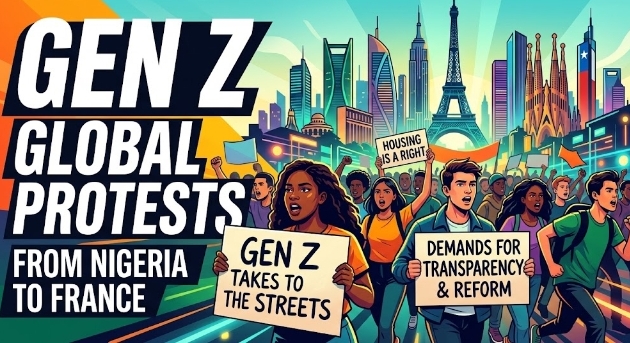
Historically, this type of intense political friction was seen primarily in developing nations. Activists—often older adults who had traveled abroad—demanded transparency, accountability, and good governance. Today, Generation Z is holding every nation accountable. Protests are evolving rapidly as this generation exerts continuous pressure on political systems, regardless of a nation's economic standing.
Consider Nigeria in 2020: for the first time, massive crowds of young people poured into the streets demanding better governance, sparking a movement initially ignited by protests against police brutality.
In the past, many assumed that life in developed nations was vastly superior to life under struggling third-world administrations. Recent events, however, challenge that assumption:
In India, Gen Z protesters across several regions have taken over the streets of India, echoing African youth in their demands for transparency and political accountability.
In France, young demonstrators have spent days and nights protesting, demanding fundamental improvements to public education and school infrastructure.
In Spain, protests have erupted over the cost of living, with youth calling for affordable housing and rent controls.
In Chile, demonstrators took to the streets to challenge controversial government budget cuts, pushing back against austerity measures.
While these requests vary by location, the underlying drive is identical: Gen Z wants structural change, better opportunities, and public accountability. However, a disconnect often exists between these demands and fiscal reality. Governments frequently promise unrealistic outcomes during election cycles, only to struggle with implementation, while hiding administrative setbacks behind political rhetoric.
Take France's call for better education for instance, many young demonstrators advocate for low tuition rates or entirely free higher education—rates below what previous generations paid—without accounting for operational costs. In India, demands for general "transparency and political accountability" can be so broad that individual interpretations vary wildly.
In Chile, the controversy surrounding budget cuts often stems from perception: public services are slashed while political elites remain insulated from austerity. In Spain, the housing crisis is compounded by rapid urbanization, shifting demographics, and supply shortages—yet young citizens still expect housing prices to remain low in highly sought-after urban centers.
Ultimately, governments worldwide must recognize that they are dealing with a fundamentally different generation than the ones their political systems were designed for. To maintain stability and rebuild trust, leaders must modernize their approach and bridge the gap between public policy and the expectations of their youngest citizens.
Historically, this type of intense political friction was seen primarily in developing nations. Activists—often older adults who had traveled abroad—demanded transparency, accountability, and good governance. Today, Generation Z is holding every nation accountable. Protests are evolving rapidly as this generation exerts continuous pressure on political systems, regardless of a nation's economic standing.
Consider Nigeria in 2020: for the first time, massive crowds of young people poured into the streets demanding better governance, sparking a movement initially ignited by protests against police brutality.
In the past, many assumed that life in developed nations was vastly superior to life under struggling third-world administrations. Recent events, however, challenge that assumption:
In India, Gen Z protesters across several regions have taken over the streets of India, echoing African youth in their demands for transparency and political accountability.
In France, young demonstrators have spent days and nights protesting, demanding fundamental improvements to public education and school infrastructure.
In Spain, protests have erupted over the cost of living, with youth calling for affordable housing and rent controls.
In Chile, demonstrators took to the streets to challenge controversial government budget cuts, pushing back against austerity measures.
While these requests vary by location, the underlying drive is identical: Gen Z wants structural change, better opportunities, and public accountability. However, a disconnect often exists between these demands and fiscal reality. Governments frequently promise unrealistic outcomes during election cycles, only to struggle with implementation, while hiding administrative setbacks behind political rhetoric.
Take France's call for better education for instance, many young demonstrators advocate for low tuition rates or entirely free higher education—rates below what previous generations paid—without accounting for operational costs. In India, demands for general "transparency and political accountability" can be so broad that individual interpretations vary wildly.
In Chile, the controversy surrounding budget cuts often stems from perception: public services are slashed while political elites remain insulated from austerity. In Spain, the housing crisis is compounded by rapid urbanization, shifting demographics, and supply shortages—yet young citizens still expect housing prices to remain low in highly sought-after urban centers.
Ultimately, governments worldwide must recognize that they are dealing with a fundamentally different generation than the ones their political systems were designed for. To maintain stability and rebuild trust, leaders must modernize their approach and bridge the gap between public policy and the expectations of their youngest citizens.
Discussions (1)
Log in to comment
Or create an account
Disclaimer: Opinion Grid is not responsible for the consequence of any comment you submitted and the system may remove your comment if it violates our policy or infringes on others' rights.
Trending Discussions
From Inbox: US Relocation or N750k New Offer with Conditions and Benefits in Nigeria?
If your purpose for relocating to the US is the usual pursuit of greener pastures, remember the Yoruba adage: what you are traveling to Sokoto to find is right here in your Sokoto pocket
Portuguese Football Crisis: Now That Ronaldo Has Spoken
Ronaldo emphasized a core principle in his statement: he asked for nothing from Jorge Jesus except the honest truth. He simply did not want to be misled. Even if the truth were blunt, he wanted Jesus to say directly, Ronaldo, you are no longer neede...
JAMB to Start Conducting UTME in Canada From 2027: Beyond the Headline
Beyond the headlines, it is striking to see the children of Diaspora parents—some of whom once dismissed Nigeria and criticized its institutions—now demonstrating an interest in entering the very academic system their parents departed. This contrast ...
One Killer, Too Many Deaths: Unmasking the Secret Cult Surge from Osun to Nigeria
While election season gave cult groups access to weapons, the ongoing violence across Osogbo and beyond is largely fueled by internal cult elections, splinter groups, and personal scores. From Osun to Lagos, Cross River, and Enugu, innocent citizens ...
Ronaldo vs. Portugal: How a Legend Exits, and the Price Portugal May Pay
These are the real, long-term setbacks awaiting the Portuguese national team if they continue to treat their ultimate icon like an outsider who never contributed to their glory. Cristiano Ronaldo
Independence Day: Tinubu and the Expectations of Nigerians
While some argue that President Tinubu's speech fell short of expectations regarding concrete solutions moving forward, it clearly demonstrated that the man at the helm of affairs is not interested
Beyond the Manifesto: What Will Decide the 2027 Nigerian Polls?
A keen examination of the early preparations suggests that non-manifesto factors—rather than policy programs—are becoming the main priority for the leading contenders
Kidnappers Sentenced to Death: The Unspoken Concerns Surrounding Edo Special Court's Ruling
The quote above is part of the landmark judgment delivered on Wednesday, September 24, 2026, by an Edo Special Court—a historic day both for Edo State and for Nigeria’s broader fight against kidnapping
Babachir David Lawal and the Dilemma of Leadership Acceptability: A Case Study in Political Mechanics
Lawal’s political career demonstrates that technical qualification and executive appointments cannot substitute for organic consensus. For political parties preparing for major electoral contests, his trajectory offers a clear lesson: positional auth...
Too Good to Be True: Inside the Osogbo Food Subsidy Scam
While it is easy to blame government policies for driving up the cost of living, citizens must also exercise caution. If these operators were indeed selling stolen goods, wouldn't buying from them make customers accomplices to a crime?