
Posted on 28/09/2026 18:27:15 (14d ago) 68
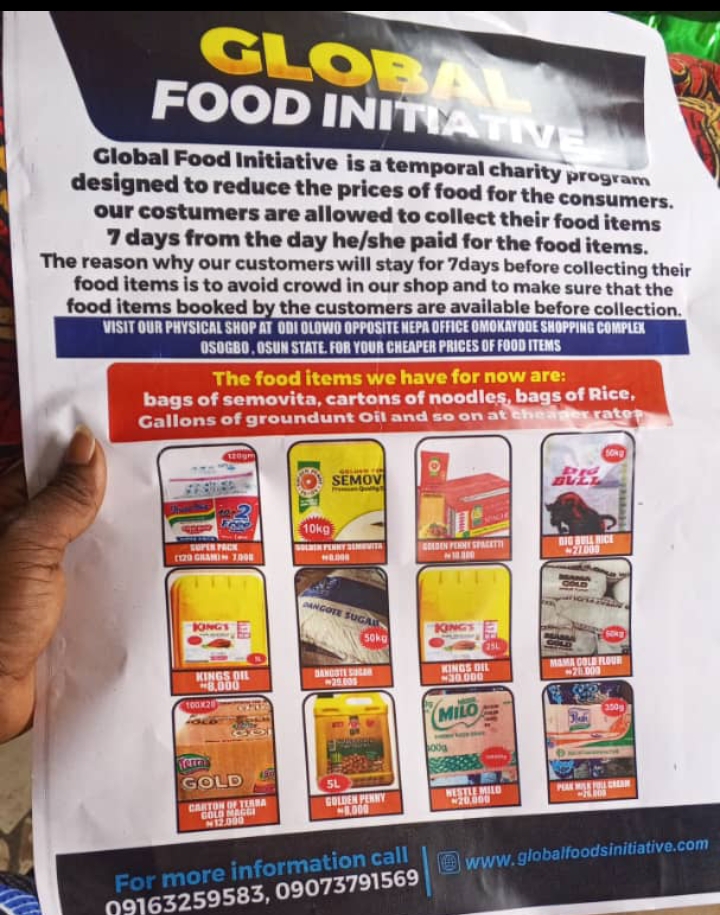
Precisely on Thursday, September 24th, 2026, a friend residing outside Osun called me, but I was unable to answer. He then left a voice note on WhatsApp attached to a picture, inquiring about a food subsidy initiative currently running in Osogbo.
Prior to his inquiry, I had no idea anything like that was happening in Osogbo, the Osun State capital. It was difficult for me to give him the go-ahead, but I also knew it would be disappointing not to provide a helpful recommendation. A few minutes later, I replied with a voice note. Later that evening, around 10:30 PM, he tried calling both my phone and WhatsApp again, but I was completely consumed by a software project I had to deliver the next morning.
Today, after witnessing a protest against the food subsidy scam, my first instinct was to open WhatsApp, go to my friend's direct messages, and review what I had actually recommended to him. I then gave him a call.
Although my friend does not live in Osun, he has family here and is a very caring person. Even without asking, I understood he wanted to place an order for them. What I had shared earlier turned out to be a relief—when we spoke on the phone today, he mentioned he wasn't hit hard by the scam because he followed my recommendation to the letter.
Initially, my friend wasn't concerned about it being a scam; he was just curious if the items sold were fake. The group listed vegetable oil, rice, noodles, pasta, sugar, flour, and semovita, among other staples, at unusually affordable prices.
What I had told him was simple: "I haven't heard about them, and I'm not sure about their business practices, but whatever you choose to buy, make sure to place a very small order for now. Don't pay for anything expensive. Just test them with one or two low-cost items."
Regarding whether the items were fake, I added: "They likely aren't selling fake items, but pay attention to the price difference between what they are offering and the actual market rate. If the price gap is too wide, don't buy it—it could be a scam. They are buying these goods from the same markets as local traders, so they can only afford to reduce their profit margin slightly. The only other possibility is that they are selling smuggled goods bought from customs officers, and even then, the price difference wouldn't be drastically lower. Above all, do not place a large order. I'll verify their business in person when I head out because the whole setup seems questionable."
Those were my exact words to him. Unfortunately, today I learned that the entire operation was indeed a scam.
During our call today, my friend confessed that his sister residing in Osogbo had already paid them but my advice made him suspicious, especially when the organizers asked customers to pick up their items 7 days after making payment. When I asked about their pricing, he mentioned that a 50kg bag of rice was being offered for ₦27,000.00—roughly 50% below the current market price. I simply responded, "That was too good to be true."
It is hard to imagine that anyone who paid these criminals isn't regretting it now. Selling a 50kg bag of rice for ₦27,000 should have raised immediate red flags. If the seller wasn't dealing in smuggled goods, they were likely a robber trying to clear stolen items quickly for cash.
While it is easy to blame government policies for driving up the cost of living, citizens must also exercise caution. If these operators were indeed selling stolen goods, wouldn't buying from them make customers accomplices to a crime?
While calling on the government and the Nigeria Police Force to fish out the scammers operating under the name "Global Food Initiative," the public must also remain vigilant and skeptical of deals that seem impossible.
Prior to his inquiry, I had no idea anything like that was happening in Osogbo, the Osun State capital. It was difficult for me to give him the go-ahead, but I also knew it would be disappointing not to provide a helpful recommendation. A few minutes later, I replied with a voice note. Later that evening, around 10:30 PM, he tried calling both my phone and WhatsApp again, but I was completely consumed by a software project I had to deliver the next morning.
Today, after witnessing a protest against the food subsidy scam, my first instinct was to open WhatsApp, go to my friend's direct messages, and review what I had actually recommended to him. I then gave him a call.
Although my friend does not live in Osun, he has family here and is a very caring person. Even without asking, I understood he wanted to place an order for them. What I had shared earlier turned out to be a relief—when we spoke on the phone today, he mentioned he wasn't hit hard by the scam because he followed my recommendation to the letter.
Initially, my friend wasn't concerned about it being a scam; he was just curious if the items sold were fake. The group listed vegetable oil, rice, noodles, pasta, sugar, flour, and semovita, among other staples, at unusually affordable prices.
What I had told him was simple: "I haven't heard about them, and I'm not sure about their business practices, but whatever you choose to buy, make sure to place a very small order for now. Don't pay for anything expensive. Just test them with one or two low-cost items."
Regarding whether the items were fake, I added: "They likely aren't selling fake items, but pay attention to the price difference between what they are offering and the actual market rate. If the price gap is too wide, don't buy it—it could be a scam. They are buying these goods from the same markets as local traders, so they can only afford to reduce their profit margin slightly. The only other possibility is that they are selling smuggled goods bought from customs officers, and even then, the price difference wouldn't be drastically lower. Above all, do not place a large order. I'll verify their business in person when I head out because the whole setup seems questionable."
Those were my exact words to him. Unfortunately, today I learned that the entire operation was indeed a scam.
During our call today, my friend confessed that his sister residing in Osogbo had already paid them but my advice made him suspicious, especially when the organizers asked customers to pick up their items 7 days after making payment. When I asked about their pricing, he mentioned that a 50kg bag of rice was being offered for ₦27,000.00—roughly 50% below the current market price. I simply responded, "That was too good to be true."
It is hard to imagine that anyone who paid these criminals isn't regretting it now. Selling a 50kg bag of rice for ₦27,000 should have raised immediate red flags. If the seller wasn't dealing in smuggled goods, they were likely a robber trying to clear stolen items quickly for cash.
While it is easy to blame government policies for driving up the cost of living, citizens must also exercise caution. If these operators were indeed selling stolen goods, wouldn't buying from them make customers accomplices to a crime?
While calling on the government and the Nigeria Police Force to fish out the scammers operating under the name "Global Food Initiative," the public must also remain vigilant and skeptical of deals that seem impossible.
Discussions (0)
Log in to comment
Or create an account
Disclaimer: Opinion Grid is not responsible for the consequence of any comment you submitted and the system may remove your comment if it violates our policy or infringes on others' rights.
Trending Discussions
From Inbox: US Relocation or N750k New Offer with Conditions and Benefits in Nigeria?
If your purpose for relocating to the US is the usual pursuit of greener pastures, remember the Yoruba adage: what you are traveling to Sokoto to find is right here in your Sokoto pocket
Gen Z Takes To The Streets: From the Developing World to the Developed, the Demands Remain the Same
Driven by a global demand for transparency, accountability, and systemic reform, Generation Z is rewriting the rules of political activism. From developing nations to world superpowers, this article explores how young citizens are taking to the stree...
Portuguese Football Crisis: Now That Ronaldo Has Spoken
Ronaldo emphasized a core principle in his statement: he asked for nothing from Jorge Jesus except the honest truth. He simply did not want to be misled. Even if the truth were blunt, he wanted Jesus to say directly, Ronaldo, you are no longer neede...
JAMB to Start Conducting UTME in Canada From 2027: Beyond the Headline
Beyond the headlines, it is striking to see the children of Diaspora parents—some of whom once dismissed Nigeria and criticized its institutions—now demonstrating an interest in entering the very academic system their parents departed. This contrast ...
One Killer, Too Many Deaths: Unmasking the Secret Cult Surge from Osun to Nigeria
While election season gave cult groups access to weapons, the ongoing violence across Osogbo and beyond is largely fueled by internal cult elections, splinter groups, and personal scores. From Osun to Lagos, Cross River, and Enugu, innocent citizens ...
Ronaldo vs. Portugal: How a Legend Exits, and the Price Portugal May Pay
These are the real, long-term setbacks awaiting the Portuguese national team if they continue to treat their ultimate icon like an outsider who never contributed to their glory. Cristiano Ronaldo
Independence Day: Tinubu and the Expectations of Nigerians
While some argue that President Tinubu's speech fell short of expectations regarding concrete solutions moving forward, it clearly demonstrated that the man at the helm of affairs is not interested
Beyond the Manifesto: What Will Decide the 2027 Nigerian Polls?
A keen examination of the early preparations suggests that non-manifesto factors—rather than policy programs—are becoming the main priority for the leading contenders
Kidnappers Sentenced to Death: The Unspoken Concerns Surrounding Edo Special Court's Ruling
The quote above is part of the landmark judgment delivered on Wednesday, September 24, 2026, by an Edo Special Court—a historic day both for Edo State and for Nigeria’s broader fight against kidnapping
Babachir David Lawal and the Dilemma of Leadership Acceptability: A Case Study in Political Mechanics
Lawal’s political career demonstrates that technical qualification and executive appointments cannot substitute for organic consensus. For political parties preparing for major electoral contests, his trajectory offers a clear lesson: positional auth...